

Will Solar+Battery Change Your Houston Homeowners Insurance? What to Ask Before You Install
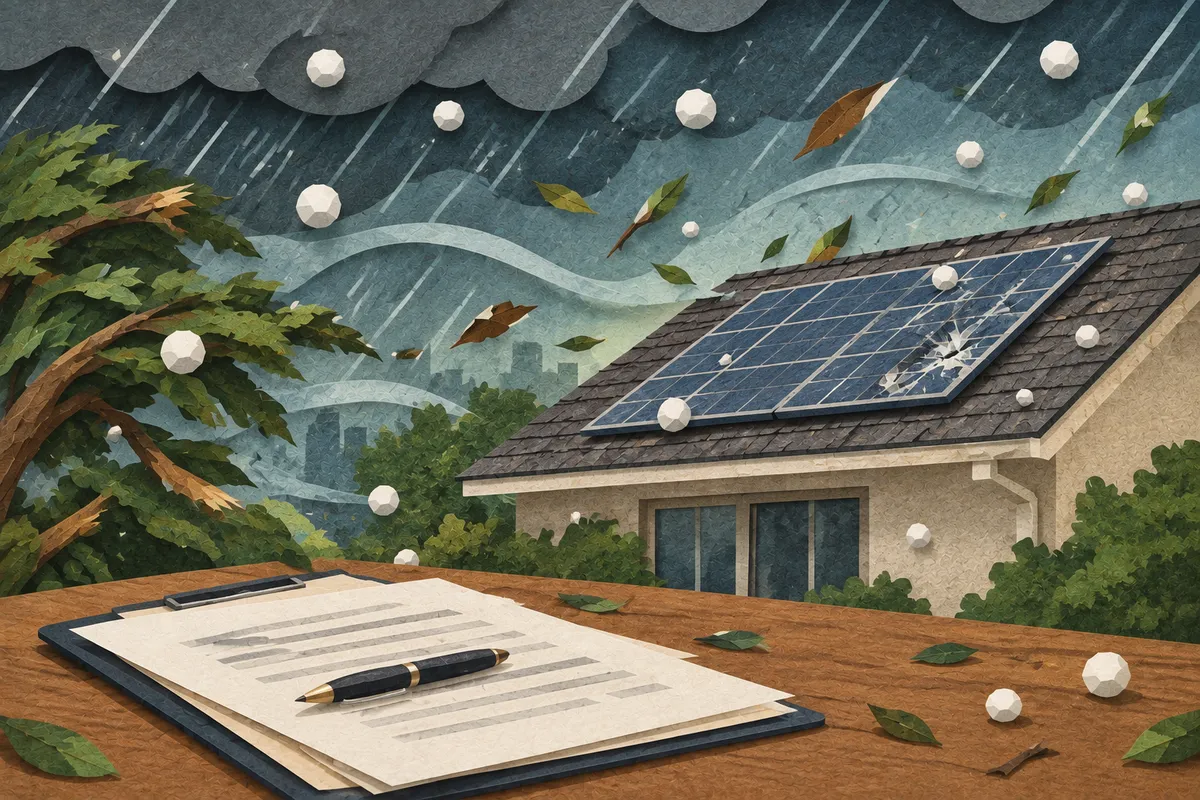
Texas homeowners insurance has gotten expensive fast. The Texas Department of Insurance reports that the average annual premium rose from $1,961 in 2019 to $3,291 in 2024, and hail accounted for close to half of the roughly $10.2 billion in homeowners losses insurers paid in 2024. So when someone proposes putting new equipment on your roof, "what will my insurance say?" isn't a nervous question. It's the right one. If you're considering a solar subscription for your Houston home, here's what to check with your insurer, with the solar company, and with your own roof before anything goes up.
What's Behind the Bill, and Why Houston Is a Wind Story Too
The statewide numbers above come from TDI's homeowners insurance market overview. Its peril chart puts hail at about $4.9 billion of paid losses in 2024, followed by wind at about $2.2 billion, water and freeze at about $1.6 billion, and fire at about $1.1 billion. The same page has a county-by-county map of average premiums if you want to see your own area. A Texas 2036 analysis of the Rice University Kinder Institute's work found that the median Texas county's average premium rose 74 percent between 2009 and 2024 after adjusting for inflation.
Those are statewide figures, so they don't tell you what hail or wind will do on your street. What we do know is that Houston has seen what wind can do. On May 16, 2024, severe thunderstorm winds tore through the city. The National Weather Service estimated winds reached 100 mph, at least seven people died, and Gallagher Re expected insured losses above $1 billion. Whatever sits on your roof needs to be thought about in that light, which is why wind belongs in the conversation right next to hail.
One more Houston detail. If you live in part of Harris County, your wind and hail coverage may not come from a regular insurer. The Texas Windstorm Insurance Association, which covers wind and hail only, serves part of Harris County, east of Highway 146 and inside the city limits of La Porte, Morgan's Point, Pasadena, Seabrook and Shore Acres. To qualify, a property has to have been turned down by at least one private insurer. Flood is a different matter, and TDI notes that you can buy separate policies for floods.
The Number to Check First Is Your Wind and Hail Deductible
TDI says a deductible can be a flat dollar amount or a percentage, and it wants you to know how a percentage translates into dollars. Its own example uses a home insured for $150,000. A 5 percent deductible there is $7,500, so a $6,500 hail repair to the roof wouldn't be paid at all. At Houston scale, a 2 percent deductible on a home insured for $400,000 would come to $8,000. That's an illustration, and your policy sets the real figure.
TDI also notes that home insurance deductibles apply to each claim, not once a year, and that a higher deductible generally means a lower premium but more out of pocket when you file. Pull up your declarations page, find the wind and hail line, and convert it to dollars. TDI recommends shopping for coverage regularly, and you can compare policies sold in your area on HelpInsure.com.
How Panels Are Tested, and Why the Basic Standard Isn't the Whole Story
Standard panel certification (IEC 61215) includes a hail test that fires 25 mm ice balls, roughly quarter-size, at 23 meters per second. The independent testing lab PVEL says that baseline offers insufficient proof of hail resistance for hail-prone regions, and runs its own tougher sequence with 50 mm balls at 32 meters per second. Its early results don't hand down a simple winner. Panels with glass on both sides resisted cell damage from hail better, while panels with a polymer backsheet were less likely to have the glass itself break. The takeaway is that "hail tested" can mean different things, and it's fair to ask what a specific panel was tested to.
According to Insurance Journal's reporting, SEIA's vice president of technical services says a UL 61730 rating signals a panel passed hail testing, which is a useful thing to ask about. For wind, the equivalent question is what wind speed the mounting system was designed for, and whether the installer designed for Houston conditions specifically.
There's a local data point too, with a caveat. A March 2024 hailstorm hit the Fighting Jays solar farm in Fort Bend County, and pv magazine reports the cleanup is expected to cost hundreds of millions of dollars. DNV estimates hail has cost Texas solar projects more than $600 million since 2018. Utility-scale farms use different equipment and mounting than a home roof, so this isn't a prediction for your house. It does show why insurers pay close attention to hail resilience.
If You Don't Own the Panels, Who Insures Them?
When you buy a system, the panels become part of your home and your insurer needs to know about them. With a subscription or lease, the equipment belongs to the provider instead. Insurance guides like The Zebra's say you aren't required to insure a leased solar system yourself, because that responsibility lies with the company that services it, though they still recommend telling your insurer about any solar installation. The same Insurance Journal report quotes the CEO of kWh Analytics saying that owners of leased or PPA systems should contact their equipment provider to find out who insures the system, and that typically the provider is responsible for that. Details vary by company, so get the answer in writing before you sign anything.
Even when you don't own the equipment, letting your insurer know is a good habit, since your policy is the one covering the roof underneath.
Your Roof Comes First
Panels are built to last decades, and roofs don't always keep pace. EnergySage's guidance is that if your asphalt roof is more than 10 years old, you should probably replace it before going solar, since panels typically run 25 to 30 years and asphalt roofs about 30. If you own your panels and need a new roof later, EnergySage puts removing and reinstalling them at $1,500 to $6,000, and says it could top $7,000. Under a subscription, who handles and pays for that depends on the provider's terms, so ask before you sign.
The roof matters on the insurance side too. TDI's shopping worksheet has a separate line for the roof, asking whether it's valued at replacement cost or actual cash value. On an older roof that distinction can change what a hail or wind claim pays, so find out which one you have before storm season.
Questions to Ask Before You Install
Ask your insurance agent:
What is my wind and hail deductible, in dollars?
Does my policy pay replacement cost or actual cash value on the roof?
Do you need to note the system on my policy, and would that change my premium?
If hail or wind damages both my roof and the panels, how would the claim work?
Ask any solar company before you sign:
Who insures the panels and the battery, and who handles a storm claim on them?
What hail testing has this panel model passed beyond the basic standard, and what wind speed is the mounting designed for?
If my roof needs work later, who pays to remove and reinstall the equipment?
Will you inspect my roof first, and what happens if a leak traces back to the installation?
Nobody should have to guess what's sitting on their roof. If you want to talk through how a solar subscription could work for your home, see if your home qualifies for a personalized look.


