

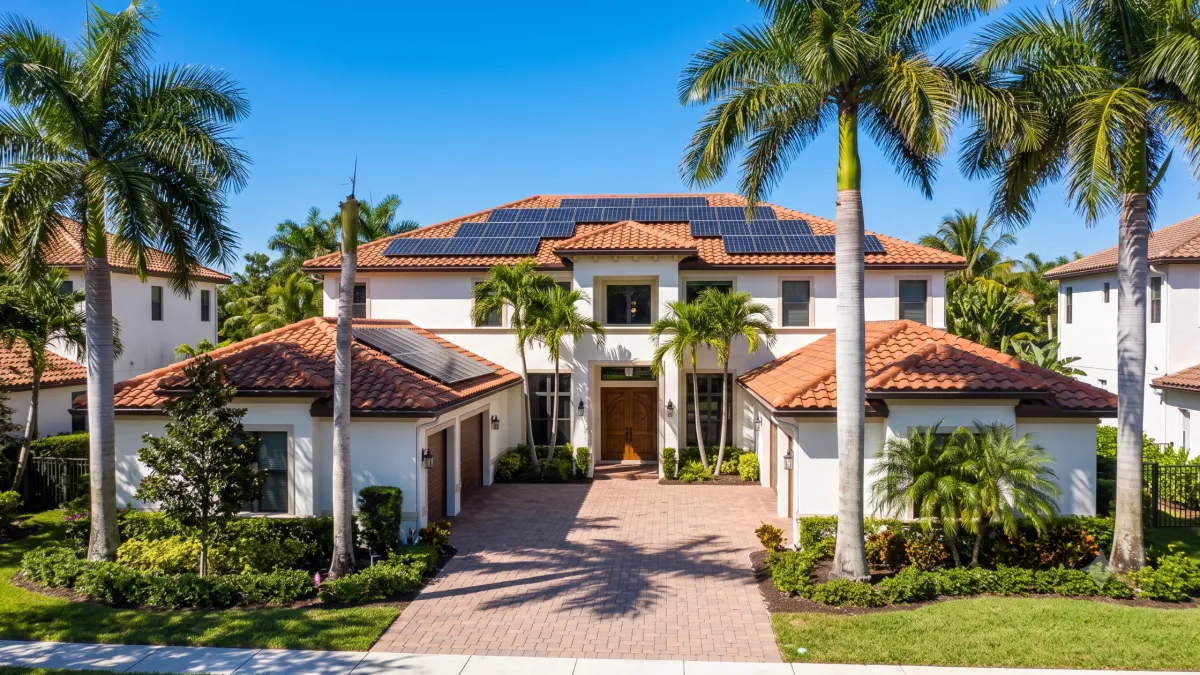
How Much Does Solar Really Cost in Miami? (2026 Breakdown)
Buying a solar system in Miami costs about $35,600 on average in 2026 before incentives, and adding a home battery for backup power can add roughly $11,000 to $15,000 more. Since January 1, 2026, the 30% federal tax credit is no longer available for systems homeowners buy and own, so that full price now lands on the homeowner. A Terra Energy solar subscription changes the math: $0 upfront costs for qualified homeowners, no loans or liens, and a monthly rate with a predictable annual increase, not a surprise rate hike.
What Does It Cost To Buy a Solar System in Miami in 2026?
The average Miami homeowner who buys solar outright in 2026 pays about $35,600 before incentives. That figure comes from EnergySage's Miami market data as of June 2026, which puts the average price at $2.37 per watt for a 15.01-kilowatt (kW) system, with most quotes falling between about $30,300 and $41,000.
If "per watt" is new to you, here's the simple version. Solar systems are sized by how much power they can produce, measured in watts or kilowatts (1 kW = 1,000 watts). Installers price by the watt so you can compare quotes fairly, even when system sizes differ. Miami homes tend to need larger systems than the national average because air conditioning runs most of the year.
Estimates vary by source. HomeAdvisor puts the average Miami installation at $33,150, with a range of $20,500 to $45,800. Your own price will depend on a few things:
System size, which follows how much electricity your home uses each month
Your roof, including its age, shape, shading, and whether it needs repairs first
Equipment, since higher-efficiency panels and inverters cost more
Permits and labor, which vary across Miami-Dade municipalities
Battery backup, which is priced separately and covered below
The State of Florida does help a little. Solar equipment is exempt from the state's 6% sales tax, and the added home value from a solar system is exempt from property taxes. Those savings are already built into most quotes, so they won't shrink the price you see.
Why Did Solar Get More Expensive for Miami Homeowners in 2026?
The 30% federal solar tax credit for homeowners ended on December 31, 2025. For years, that credit (officially the Residential Clean Energy Credit, or Section 25D of the tax code) took a large bite out of the price of buying solar. Under the One Big Beautiful Bill Act, signed July 4, 2025, systems placed in service in 2026 or later no longer qualify. The credit had originally been scheduled to run through 2032.
Here's what that means in real numbers. On average, for a Miami system of about $35,600, the old 30% credit would have been worth roughly $10,700. In 2026, a homeowner who buys that same system pays the full amount. Batteries lost the credit too, so a battery a homeowner adds in 2026 does not qualify either.
A few things are still true for Miami homeowners:
If your system was installed and running by December 31, 2025, you can still claim the credit on your 2025 return, and unused credit can carry forward to future tax years.
Florida's sales tax and property tax exemptions for solar are still in place.
Tax situations vary, so talk with a tax professional about your specific case.
The bigger takeaway is simple. Buying solar in 2026 means covering the entire cost yourself, either in cash or through a loan. That makes it worth looking closely at options that don't require a large upfront payment.
What Are the Hidden Costs of Owning Solar in Miami?
The sticker price is only part of what solar ownership costs. Most Miami homeowners don't pay $35,000 in cash, so they take out a solar loan, and that's where the real price of traditional solar shows up.
Interest and loan fees. Financing raises the price before you even count interest. SolarReviews estimates that Florida solar bought with a loan costs about $3.25 per watt, compared to $2.71 per watt paid in cash. That's roughly 20% more, driven by lender fees built into the price.
Liens on your home. Many solar loans place a lien on your property. That can complicate things if you want to sell or refinance before you pay off the loan.
Long contracts. Most solar contracts last up to 25 years. That's a long commitment for a technology that keeps improving and a home you may not live in forever.
Maintenance and repairs. When you own the system, you're responsible for repairs outside the warranty. So is keeping an eye on whether it's producing what it should.
Backup power costs extra. Here's something many homeowners don't realize: standard grid-tied solar panels typically shut off during a power outage to protect utility workers. To keep the lights on during a storm, you need a battery. In Miami-Dade County, a typical 13 kilowatt-hour home battery costs about $12,800 installed, with most quotes between $10,900 and $14,800.
Add it up, and a purchased solar-plus-battery system in Miami can easily approach $50,000 once you include financing. That's the number that keeps many homeowners from going solar.
What Does It Cost Miami Homeowners To Skip Solar?
Not going solar has a cost too, and for Miami homeowners it rises every year. Florida Power & Light (FPL), which serves most of Miami-Dade County, raised its rates again in January 2026.
Under a four-year rate agreement the Florida Public Service Commission approved in November 2025, FPL's typical residential bill for 1,000 kilowatt-hours rose $2.50 a month in 2026, to $136.64. That agreement sets rates through 2029. FPL itself projects about a 2% average annual increase in typical residential bills through the end of the decade. The overall increase is roughly $6.9 billion, which opponents described as the largest rate hike in U.S. history.
Keep in mind that 1,000 kilowatt-hours is a benchmark, not a Miami average. Many Miami homes use far more, especially in summer, so real bills climb faster than the headline number.
Then there's hurricane season. When the grid goes down, a home without battery backup goes dark, whether or not it has solar panels. For many Miami families, the cost of an outage shows up as spoiled food, a hotel stay, or a noisy generator that burns fuel and saves nothing on the monthly bill.
So the real comparison isn't "solar versus nothing." It's solar versus years of rising utility costs and no backup plan when the power goes out.
How Does a Solar Subscription Change Miami Homeowner Costs?
A solar subscription removes the biggest cost barrier entirely: you don't buy the system. With Terra Energy's solar subscription, qualified Miami homeowners pay $0 upfront and a monthly rate that covers the system and the energy it produces, with a predictable annual increase, not a surprise rate hike. There are no loans or liens, and the initial term is just 3 years. And if you sell your home, the subscription can transfer to the new homeowner, or we can work with you to close it out.
We built it this way because we think the solar industry's problem was never solar. It was financing. Homeowners wanted clean, affordable energy, and they were handed 25-year loans and liens to get it. Here's how the options compare for a Miami home:
Buy with cash | Solar loan | Terra Energy solar subscription | |
Upfront cost | About $35,600 on average, before incentives | Often little down, but interest and fees raise the total | $0 upfront for qualified homeowners |
Federal tax credit in 2026 | None | None | Not needed; you don't buy the system |
Lien on your home | No | Often | No |
Commitment | You own it for its lifetime | Often up to 25 years | Initial 3-year term |
Maintenance and repairs | Your responsibility outside warranty | Your responsibility outside warranty | Included |
Battery backup | About $10,900 to $14,800 extra | Added to the loan balance | Available with the subscription |
The results speak for themselves. Homeowners can save up to 50% on their monthly electric bills. Customers can cancel after the initial 3-year term, but 98% choose to stay.
One of our Florida customers put it better than we could:
"For those that are skeptical about going Solar, These folks are the real deal! The process was effortless. They honored all commitments and timelines and the system is working great! Literally zero out of pocket, no liens, no long term lease commitments." — Sheila Morgan
You can read more stories from Florida homeowners on our customer testimonials page.
How Can You Find Out What Solar Will Cost for Your Miami Home?
The most accurate way to know what solar will cost for your home is a personalized savings analysis based on your actual electricity use. Whether you buy, finance, or subscribe, these steps will help you compare options clearly:
Gather 12 months of FPL bills. Your yearly usage, not one summer month, tells you what size system your home needs.
Ask for the full cost, not just the sticker price. For any purchase quote, ask for the price per watt, the battery cost, the total interest paid over the loan, and whether a lien is involved.
Compare commitment length. A 25-year contract and a 3-year initial term carry very different levels of risk.
Check what's included. Find out who pays for maintenance, monitoring, and repairs after installation.
Plan for hurricane season. Ask whether the system includes battery backup, and what it will keep running during an outage.
Is a solar subscription a fit for your home? It’s a great fit if you own your home, your roof is in good shape, and you use about 1,000 kWh or more per month (an average bill of $150 or higher). It may not be the right moment if you rent or live in a condo, or if your roof has heavy shading or needs repairs first.
If you're ready to see how a solar subscription could lower your energy costs, we'll walk you through the numbers with no pressure. See if your home qualifies for a personalized savings analysis.


