

Houston's "$0 Upfront" Electricity and Solar Subscription Too Good to Be True?
If an offer for $0 upfront electricity, solar, and battery backup sounds too good to be true, that skepticism is fair. Houston's electricity market has given people plenty of reasons to read the fine print twice. Below, we walk through exactly how TerraOne, Terra Energy's Houston subscription, works, why it isn't a loan or a teaser rate in disguise, and where the real limits are, so you can judge it on the facts instead of the pitch.
What Is TerraOne, Exactly?
TerraOne bundles three things Houston homeowners normally buy separately: your electricity plan, rooftop solar, and a whole-home battery, into one flat monthly subscription. Instead of shopping for a retail electricity provider (REP) and then separately financing solar, you pay a single all-in rate, currently around 11 cents per kWh, that already includes CenterPoint's TDU delivery charges. There's no separate CenterPoint line item to track down. Terra Energy acts as your REP in Texas through its licensed entity, Light Energy LLC, the same regulatory role any electricity company in the state has to register for with the Public Utility Commission of Texas (PUCT).
Why Doesn't TerraOne Require a Loan or a Lien?
This is usually the first question we get, and it's a fair one, especially in a state where most solar pitches still mean a 20 to 25 year loan or lease.
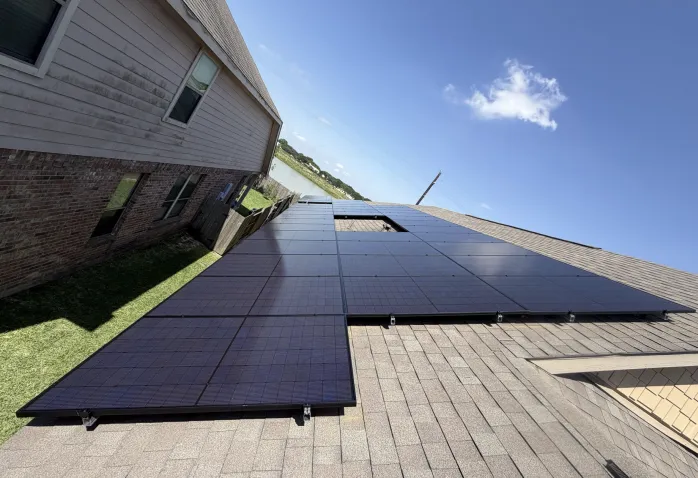
A solar loan means you own the equipment and owe a lender for it. A TerraOne subscription means Terra Energy owns and maintains the solar panels and battery, and you pay a monthly rate for the electricity they produce, plus your grid usage, similar to how you'd pay for any other home service. Because there's no loan, there's no lien, and nothing gets attached to your property title.
That's also the structural reason every TerraOne rate has to be checked against the same yardstick every other Texas electricity plan is checked against: the Electricity Facts Label. Texas has required an EFL on every residential plan since the state's retail market deregulated in 2002, specifically so customers can compare the real price at their actual usage level instead of a headline number. TerraOne's rate is designed to stay competitive against your EFL, not just against a teaser number, though it will vary by usage, location, and system size, so no single figure is a guarantee before you've run your own numbers.
What Happens After the Minimum Term?
TerraOne's initial term is 36 months. If you leave before that, there's an early termination fee of $395. After the 3-year mark, you can cancel with no penalty, upgrade your system, or simply continue, and the rate doesn't jump the way some Texas plans do once a promotional period ends. There's also a small 1.9% annual adjustment built in and disclosed upfront, well under what most Houston households have seen from utility rate increases in recent years.
Does It Actually Help When Houston's Grid Is Under Strain?
For Houston homeowners, this question tends to matter as much as the cost question, and 2024 is still fresh in a lot of people's minds. Hurricane Beryl knocked out power to roughly 2.2 to 2.6 million CenterPoint customers in July 2024, and more than 260,000 households were still without power a full week later. That's not a hypothetical scenario, it's a recent one.
The grid pressure isn't only about hurricanes, either. In July 2026, ERCOT set a new all-time demand record twice in two days, hitting 87,403 megawatts on July 21 and 91,308 megawatts the next day, driven by extreme heat and rising data center load. What kept the grid from issuing conservation alerts at those record numbers was largely the solar and battery capacity Texas has added in recent years. Statewide solar capacity more than doubled between 2023 and 2025, and battery storage more than tripled over the same period.
Every TerraOne subscription includes a 40 kWh whole-home battery at no extra charge. It stores solar energy for daily use and switches on automatically when the grid goes down, covering essential loads without you having to do anything. A generator can help during an outage, but it does nothing for your monthly bill the other 363 days of the year. A solar-charged battery does both.
So What's the Actual Catch?
Here's the honest answer: it's not free, and it's not a fixed guarantee. Every homeowner pays a predictable monthly rate. It's "$0 upfront" as in no large payment on day one, not "$0" as in no cost at all. Terra Energy customers see savings of up to 50%, though most see closer to 40%, depending on the home's current usage, rate, and location, which is why we walk every homeowner through a personalized estimate before enrollment rather than a blanket promise.
There's also a real, well-documented pattern in the Texas market worth knowing about before you compare TerraOne to any other offer: some Texas electricity plans advertise a low rate that only applies right around 1,000 kWh of monthly usage, with a bill credit that disappears above or below that specific number. TerraOne doesn't use that structure. The all-in rate is the rate. On the solar side, Texas also has no statewide net metering mandate, so buyback credit for excess solar you send back to the grid depends entirely on your REP, typically somewhere between 3 and 12.5 cents per kWh across the market. TerraOne's buyback credit for excess production is 4 cents per kWh, which is a normal, market-consistent number, not a headline figure.
The other honest answer is that TerraOne only works for homes that qualify, based on things like roof condition, sun exposure, and credit (a 650 minimum, with some flexibility case by case). That's also why Terra Energy has a Net Promoter Score of 71 and a 98% customer retention rate: the homeowners who go through with it tend to be genuinely happy with the outcome, not surprised by hidden terms later.
What Houston Homeowners Are Saying
Skepticism is the most common reaction we hear before someone enrolls in TerraOne, especially from homeowners who already know how confusing Texas electricity plans can be.
"No regrets, I love Gabby my representative." -Sharri, TerraOne customer, went from $450-$500 a month to $210 with a 42-panel system.
How To Find Out If Your Home Qualifies
The only way to know what TerraOne would actually look like for your home, your roof, your current CenterPoint bill, your usage, is a personalized savings analysis. There's no obligation, and pricing isn't discussed until you're ready.
Get a quote to find out what your home could qualify for.


