
Answers,
right when you need them.
Knowledge beautifully organized
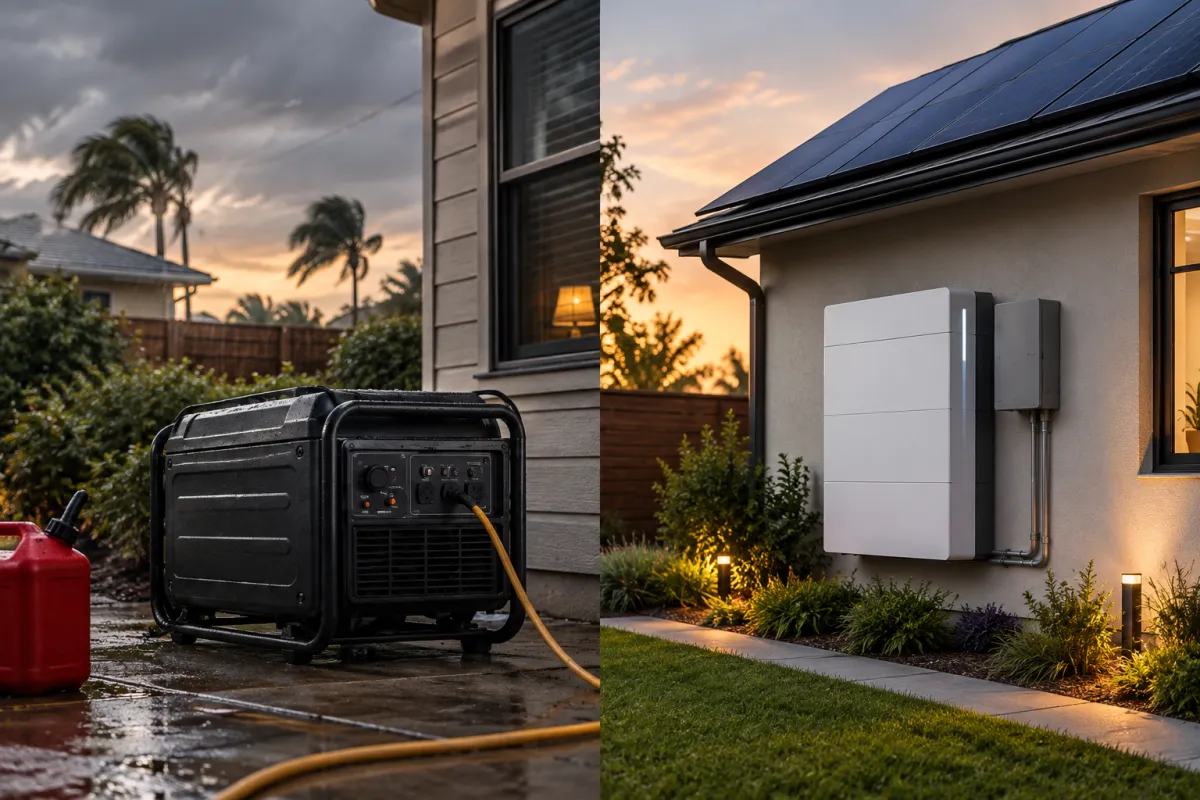
What Hurricane Beryl Actually Showed Houston About Generators, and What Battery Backup Covers Instead
After Hurricane Beryl knocked out power across Houston in July 2024, roughly 400 people in the area ended up in emergency rooms for carbon monoxide poisoning, the highest number since the 2021 winter freeze, according to state data reported by the Texas Tribune. At least two of those cases were fatal. Almost all of them had the same cause: a portable generator, run too close to the house, trying to keep the air conditioning going in triple-digit heat. A whole-home battery backup system that comes with your solar panels removes that risk entirely, along with several other generator problems Houston already knows well. Here's what TerraOne's battery actually covers, and how it stacks up against the generator sitting in your neighbor's driveway.
What TerraOne's Battery Actually Covers
Every TerraOne installation includes a 40 kWh whole-home battery at no additional cost. It stores the solar energy your panels generate during the day, and the moment CenterPoint's grid goes down, it switches on automatically, no pull cord, no extension cords run through a window, no manual transfer switch. For most homes, it covers a full day of essential use under normal conditions, and because it recharges from your own panels, a multi-day outage with intermittent sun doesn't leave you stuck on a single charge the way a generator leaves you stuck once the tank runs dry.
Refrigeration, lights, WiFi and phone charging, and, critically for Houston, your air conditioning are all covered on a properly sized system, not just a handful of outlets. That last part matters more here than almost anywhere else in the country. Houston's outages don't reliably happen in mild weather.
The Real Problem With Relying on a Generator in Houston
The carbon monoxide numbers after Beryl weren't a fluke or a one-off tragedy. They're the predictable result of two things happening at once: extreme heat that makes people desperate to run an AC unit off a generator, and a portable generator that produces a colorless, odorless gas capable of killing someone in an enclosed or semi-enclosed space within minutes. The Consumer Product Safety Commission's own data shows portable generators are linked to roughly 92 carbon monoxide deaths nationally in an average year, and Houston's emergency rooms saw that risk play out in real time after Beryl, with local doctors describing a steady stream of patients presenting with headaches, shortness of breath, and nausea in the days after the storm.
There's a second problem that's specific to a widespread grid outage rather than a single-home issue: you can't always get fuel. After Beryl, gas stations across the Houston area ran dry or simply couldn't operate, because most stations need electricity to run their own pumps. That created a genuinely circular problem for generator owners: the same outage that made you need gasoline for your generator also shut down the stations that sell it, and lines for the stations that did have power and fuel stretched for blocks. A battery that's already charged when the outage starts doesn't have a supply chain that can fail at the exact moment you need it.
What a Battery Doesn't Do
To be direct about the other side of this: a battery isn't unlimited, either. It's built for the outages that happen most often, a local repair after storm damage, a summer grid-strain event, a routine outage lasting a day or two, not an extended, multi-day event with heavy, continuous draw and little sunlight to recharge it. For a household running powered medical equipment around the clock, or for the rare week-long outage, a generator still has a role to play as a secondary backup, or applying for Critical Care or Chronic Condition status with your utility is worth doing ahead of time. We'd rather say plainly where the limit is than let anyone assume a battery replaces every scenario a generator covers.
How to Actually Compare the Two Before You Decide
Safety. A battery produces no exhaust and carries no carbon monoxide risk, indoors or out. A portable generator has to be run outdoors, away from windows and doors, every single time, and Houston's own post-Beryl numbers show how often that instruction gets skipped under pressure.
Fuel and refueling. A battery recharges from sunlight with no supply chain to fail. A generator is only as reliable as your stored fuel and your ability to buy more mid-outage, which Houston's own gas station lines after Beryl showed isn't guaranteed.
Noise and maintenance. A battery is silent and has no engine, oil, or spark plugs to maintain. A generator needs regular runs to stay reliable and will be audible to your entire block for as long as it's running.
What it powers. A properly sized whole-home battery covers your actual essential loads, including AC, automatically. A portable generator typically covers a limited number of circuits you manually connect, and sizing it correctly for AC specifically is a common point of confusion, as several Houston homeowners found out the hard way after Beryl.
Startup. A battery switches on the instant the grid drops. A generator requires someone to physically start it, which means no backup at all if you're not home, asleep, or unable to get to it.
How to Find Out If TerraOne Is Right for Your Home
Whether a battery alone covers your household, or whether it makes sense alongside a generator for specific equipment, depends on your home's actual usage and what you're trying to protect against. Our team can walk through what a 40 kWh battery would realistically cover for your specific home before you commit to anything.

Browse Sections
Scheduling
AGENCIES
CREATORS
INFLUENCERS
COACHES
TRAINERS
YOUTUBERS
SAASPRENEURS
AFFILIATES
Is there something you'd like to add?: laura.ramirez@terraenergy.io